Most smart home pages list 40+ features and leave you to figure out which ones you'd actually use. This page does the opposite. We've grouped what Nexomatic does into what you'd buy it for, ranked roughly by which features our customers tell us they use most.
If something here looks compelling, the book a free site visit link at the bottom maps it to your specific home. If something doesn't apply to your setup, you don't have to pay for it — every layer is optional except the core switching.
1. Saving money on your TNEB bill (the one most customers buy us for)
Tamil Nadu's electricity tariff is slab-based — every kWh after the 500 kWh slab boundary costs noticeably more than every kWh before it. Most Indian families cross slab boundaries by accident: a forgotten geyser, an AC left running on a hot afternoon, a TV in standby for 18 hours a day. By the time the bimonthly bill arrives, it's too late.
Nexomatic addresses this end-to-end:
Per-appliance energy metering. Every channel of every smart switch measures its own current and reports per-appliance kWh. Not "estimated from the total"; actually measured by hardware behind each load. The architectural reason this matters is in our power metering whitepaper if you want the deep dive.
AI bill prediction. Mid-cycle, the app uses your 30-day usage history to predict your bimonthly bill. If you're trending past a slab boundary, you get a push notification: "Your current trajectory crosses the 500-kWh boundary on the 18th. Tap to see which appliances are driving it."
Standby drain detection. The system flags appliances drawing power 24/7 but only running 2 hours a day — TVs, set-top boxes, idle refrigerators with sealing issues, broken inverter trickle-chargers. Typical Indian 2BHK has ₹150–₹400/month hiding here.
Auto-schedule suggestions. After ~14 days of data, the app suggests routines: "Your AC runs 23:00–06:30 every night; shift the geyser to 04:30–05:15 (off-peak) instead of 07:00–08:00 (peak) and save ₹220/month."
What this stack tends to save the average Tamil Nadu household: ₹950 – ₹2,500/month, depending on appliance mix and starting habits. We documented the math in the smart home cost guide — the system tends to pay for itself within 18–36 months on electricity savings alone.
2. Working when the internet doesn't (the feature that wins us India)
Most smart home brands depend on the cloud. When your ISP has a 4-hour outage at 7 PM on a Tuesday — and they do, often — your "smart" home stops responding. Lights won't dim. Schedules don't fire. The AC you scheduled to switch off at midnight stays on all night.
Nexomatic is offline-first by design:
| Capability | When internet is up | When internet is down |
|---|---|---|
| Wall switches respond to touch | Yes | Yes (no change) |
| App responds (over local WiFi) | Yes, instant | Yes, under 1 second |
| Schedules fire on time | Yes | Yes (run locally) |
| Scenes work | Yes | Yes |
| Sensor rules (motion → light) | Yes | Yes |
| Voice via Alexa | Yes | No (needs internet) |
| Remote access from outside the home | Yes | No |
The rules and schedules live on the device itself, not in the cloud. The cloud is for remote access and analytics, not for keeping your home running. When the network comes back, everything reconciles automatically — no commands are lost.
This single architectural choice is why we're not Mi Home or Smart Things. Those services routinely have nationwide outages that leave their customers literally unable to switch on a light. We don't.
3. Caring for parents at home (without making them wear anything)
If your parents live with you (or alone in another city), this section is the most important one on this page. Most elderly care tech wants them to wear a pendant, learn an app, or remember to push a button when they need help. None of those work in practice — wearables get taken off, apps don't get learned, and the people who most need help are the least likely to ask.
Nexomatic's elderly care monitoring works the opposite way: it watches whether the home is being used normally, and alerts the family if it isn't.
No-motion alerts. A PIR sensor in the room your parent uses most (typically the hall + their bedroom) learns their normal routine over 7-14 days. If the room has no motion during expected hours — say, no movement in the hall between 7 AM and 10 AM when they're usually up making chai — the family gets a push notification: "No motion in [Father's room] for 3 hours during normal active window."
Routine deviation alerts. The system also flags unusual patterns: AC running at night when it normally isn't (mom feeling unwell?), TV not on at the usual 8 PM (skipped the news?), bathroom light on for 90 minutes when it's usually 10 (a fall?).
Family circle. Up to 6 family members can receive these alerts. Adult children in different cities all get notified simultaneously. The notification includes the time-of-last-motion so you can decide if it warrants a call or not.
7 Indian languages. Alerts arrive in Hindi, Tamil, Telugu, Malayalam, Kannada, Bengali or English — your choice per family member. The parent doesn't see any of this; only the watchers do.
No wearable, no learning curve. Your parents just live in the house. Their behaviour generates the data. They don't need to install anything or remember anything. If they prefer, they can ignore that the system exists.
This is the feature that takes the longest to set up correctly (you need a few weeks of baseline data) and the one that families thank us for most.
4. Actual safety, not just notifications
Smart safety features in India are mostly notification-only — gas leak detected, push sent, "good luck." We engineer ours as action chains:
Gas leak. Sensor detects LPG/PNG → 85 dB local buzzer fires immediately → push to all family members → if you've installed the optional smart valve, the gas valve closes automatically within 5 seconds. Action chain, not just an alert.
Smoke. Photoelectric sensor with cooking-safe tuning (won't false-trigger on toaster smoke) → fires the emergency scene → all lights in the house turn on, curtains open, kitchen exhaust runs at max, AC compressors shut down, push to family. The lights-on-everywhere thing matters — it's so you can see your way out at 3 AM.
Water leak. Floor-level sensor near washing machine, geyser base, or bathroom → mains water valve closes (if installed) → push notification. Saves wood floors and the downstairs neighbour's ceiling.
PIR-based intrusion. Night-mode PIR triggers → all outdoor lights on + indoor lights at 50% (signals occupancy) + CCTV records a clip if the Hub is installed + push.
All of these run locally on the device — they work during a power-cut on the upstream router, during a cloud outage, during the worst case where the cloud company shuts down. The ESP32 inside the switch has the rules; it runs them whether or not anyone is connected to anything.
5. Family-friendly control (everyone uses what suits them)
The single biggest failure mode of a smart home is "only one person in the house knows how to use it." Our usable surface is wide enough that grandparents, kids, guests and tech-skeptical spouses all have something natural for them:
| Control surface | Best for |
|---|---|
| Wall switches (physical buttons) | Toddlers, grandparents, guests who don't want to learn anything |
| Wall switches (touch glass) | Daily use, premium feel |
| Phone app | The "smart" user — schedules, scenes, energy reports |
| Voice (Alexa) | Hands-free moments — kitchen, bath, in bed |
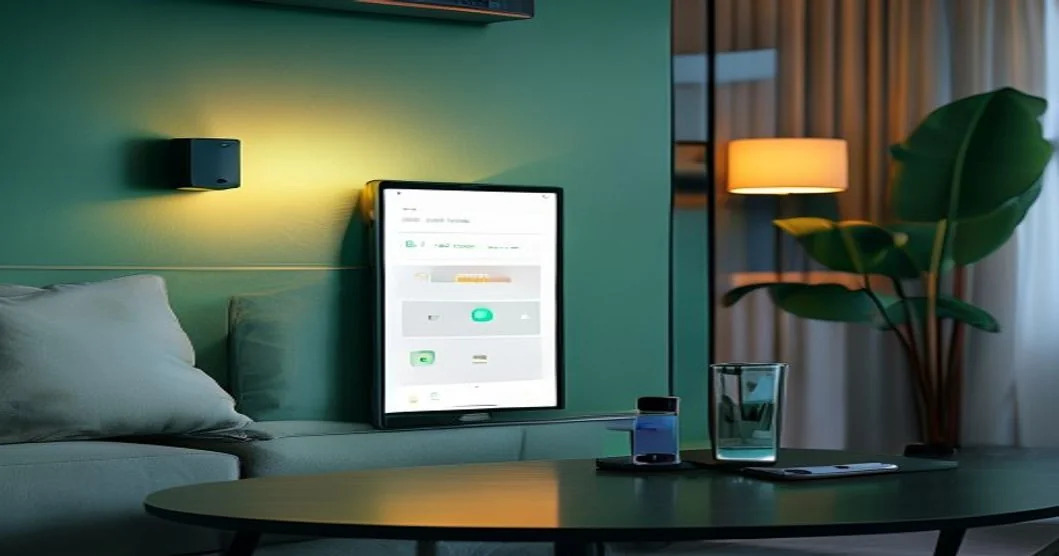
| Per-room Kiosk Tablet | Whole-family control, no-phone households, central dashboard |
| Wireless Button Switch | Stick-anywhere — bedside, sofa, near the front door |
| Geofencing (auto) | The car arrives in the geofence → gate opens, hall light on, AC starts cooling |
| Scheduled (no input) | Goodnight, Wake Up, Holiday Mode — runs without anyone doing anything |
Note that every device still has its original physical action. A wall switch is still a wall switch. If your eight-year-old wants to turn on the fan, they push the button. The smart layer adds; it doesn't remove.
6. Things you might add later (without rewiring)
Nexomatic is modular. You can start with just the wall switches and add these one at a time as you actually want them:
- Smart Gate Automation — sliding or swing gate motorisation. Three ways to open: app, RF remote, FASTag number-plate entry (the car arrives, the gate reads the plate, opens for trusted vehicles only). Entry log with timestamps for every opening.
- Nexomatic Hub (CCTV) — privacy-first local NVR. Pairs with any existing CP Plus / Hikvision / Dahua / Ezviz / Imou / Hi-Watch camera over RTSP. Recordings stay on a 1 TB SSD inside your home — no monthly cloud fee, no foreign servers. View remotely via secure tunnel that opens only when you're actively watching.
- Water Tank Automation — ultrasonic level sensor + pump relay. Auto-on when low, auto-off when full, dry-run protection prevents motor burnout when the sump is empty. Saves a ₹3-7K pump motor on the first dry-run avoided.
- IR Blaster — turns your old AC, TV, set-top box and stereo into smart devices over IR. 10,000+ models in the device library. Pair once, control forever — schedules, scenes and voice commands work via IR just like they do via the relay.
- Smart Sensors — gas, smoke, water leak, PIR motion, ambient light, temperature/humidity, door/window contact. Pick the ones you want; the system rules engine ties them to your switches automatically.
None of these require you to rebuild your network or pre-buy at install time. The wall switches are the trunk; everything else is a branch you can add when you're ready.
7. Things we don't make you compromise on
A few features that are usually paid extras with other brands — included with Nexomatic:
- Per-device unique encryption keys. Every switch ships with its own AES-256 key in secure storage. If our cloud database somehow leaked tomorrow, no attacker could control your house. (Other brands often share one key across all devices in a model line — a single leak compromises everyone.)
- No data sale. We don't sell aggregated usage data to advertisers, utility brokers, or anyone else. Built under India's DPDP Act 2023 with explicit consent gates for analytics. Our Privacy Policy is the contract.
- OTA firmware updates with auto-rollback. If a firmware update bricks something within 60 seconds, the device auto-restores the previous version. You don't lose a working switch to a bad release.
- 5-year hardware warranty. Snubber/RC failures on long PVC runs are covered; we've engineered around them but if one fails we replace it.
- Bank-grade transport security. Per-packet HMAC-SHA256 signing, 5-minute anti-replay windows, AES-256 at rest in the cloud. Stronger than what most smart meters use.
- No "monthly cloud fee" trap. Core control + scheduling + scenes + sensor rules + local app access are free forever, no subscription required. Premium and Pro tiers add things like AI bill prediction, elderly care monitoring, CCTV remote view — but the base functionality never gates behind a paywall.
What it adds up to
A Nexomatic home is not a "smart speaker connected to a few switches." It's an instrument that:
- Saves money by watching every appliance independently and warning you before bills spike
- Stays usable when the internet goes down (which it will)
- Watches your parents without making them learn anything
- Acts on safety events, not just notifies about them
- Lets every family member use the surface that suits them
- Respects your privacy under Indian law, and your wallet by not gating basics behind a subscription
That's why most of our customers come from a referral — they tried something else first, hit a problem on the list above, and switched.
Book a free site visit — we'll walk through your home and show which subset of these features actually matters for you. Some homes need elderly care and bill prediction; others need only the offline switches and a gas sensor. We'll tell you which is which on the call.
Call us: +91 75500 58208 · Mon–Fri 8:30 AM – 6:00 PM · Sat 8:30 AM – 3:00 PM